
 €490
€490
Module 03 · Recorded lecture series (streamed)
Biopsy in Tumour Diagnosis
From needle to diagnosis: sampling, handling, interpretation.
€690VAT included · per seat
- Format
- Recorded lecture series (streamed)
- Extent
- 11 h · 18 lectures
- Access
- 12 months
- Assessment
- 25 image-based questions
- Delivery
- Access details by email within 24 h
Cancel for a full refund until access is delivered. Withdrawal policy.
§1
Overview
Core-needle and fine-needle material behaves differently from resections, and most avoidable errors happen before the slide is cut. The series follows the specimen: guidance and targeting, adequacy assessment, fixation and orientation, frozen-section triage, and the interpretive limits of small samples in breast, kidney, lung and lymph node.
§2
What you will be able to do
- Judge adequacy of a core or aspirate on site and say what a repeat pass should target
- Separate crush, cautery and fixation artefacts from true pathology in small samples
- Grade on a core with the confidence the sample allows — and write the limitation
- Allocate tissue between morphology, immunohistochemistry and molecular testing before it is gone
§3
Syllabus
- Adequacy criteria and rapid on-site evaluation
- Crush, cautery and fixation artefacts
- Small-biopsy grading: what you can and cannot say
- Tissue allocation for molecular testing
- Communication with the interventional team
§4
Lesson list
| 01 | What a needle does to tissue: mechanics of core and aspiration sampling | 36 min |
| 02 | Image-guided targeting and the pathologist’s feedback loop | 41 min |
| 03 | Rapid on-site evaluation: setting up, staining, reporting adequacy | 44 min |
| 04 | Fixation: cold ischaemia, under- and over-fixation, decalcification | 38 min |
| 05 | Orientation, inking and embedding of small specimens | 29 min |
| 06 | Artefact atlas for small biopsies | 46 min |
| 07 | Frozen section triage: when to freeze a core and when not to | 33 min |
| 08–10 | Breast cores: B-categories, receptor testing on cores, discordance | 1 h 52 min |
| 11–12 | Renal mass biopsy: oncocytic tumours and the limits of the core | 1 h 14 min |
| 13–15 | Lung and EBUS: small-cell vs non-small-cell, PD-L1 on cytology | 1 h 48 min |
| 16–17 | Lymph node cores and FNA: what flow and molecular need from you | 1 h 09 min |
| 18 | Communicating with the interventional team — closing lesson | 37 min |
11 h · 18 lectures in total. Lessons can be watched in any order; the numbering is our recommendation.
§5
A sample from the module
Excerpt
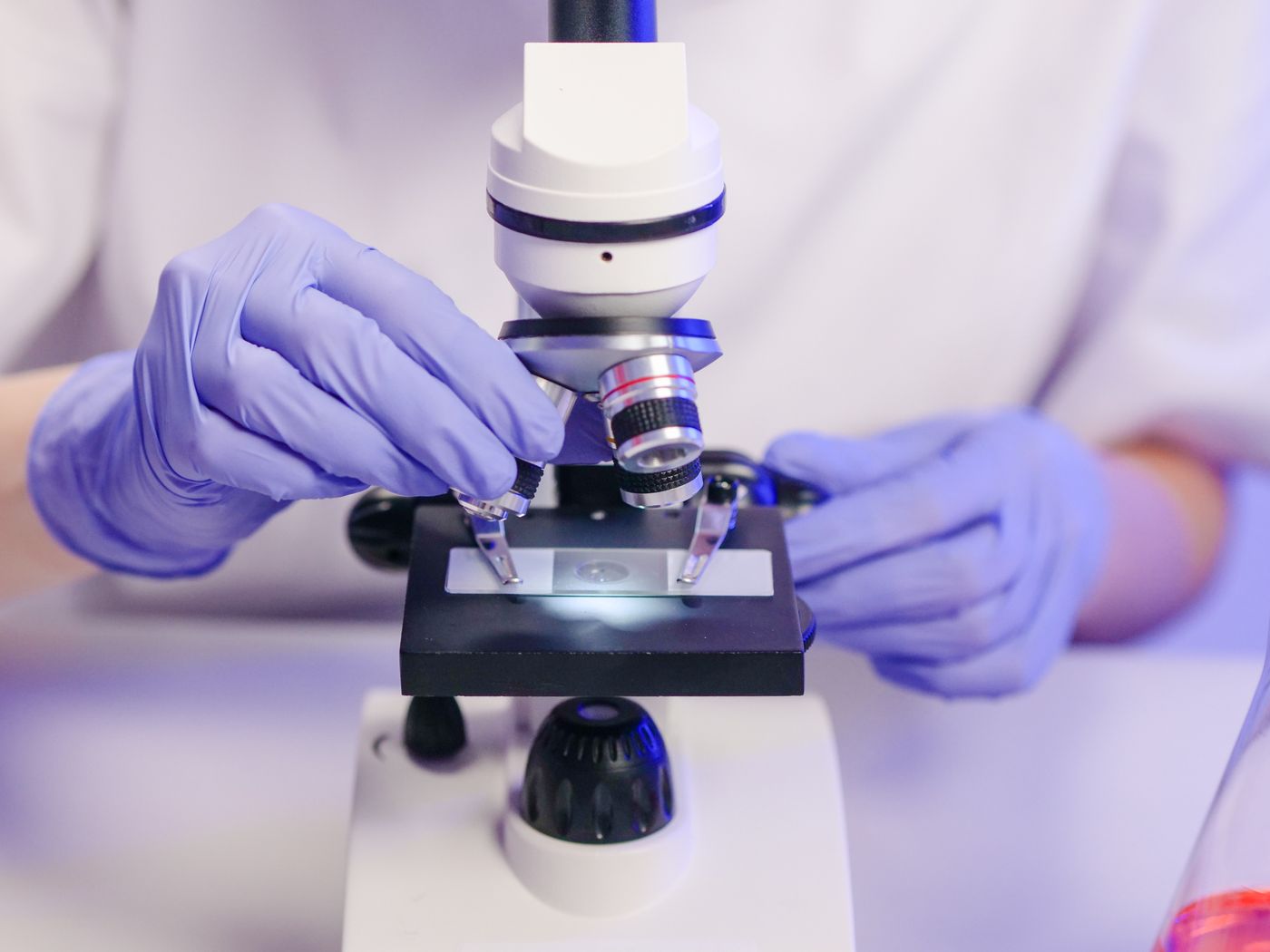
Lecture 06 — Artefact atlas for small biopsies
Forty minutes on the things that are not tumour: cautery at the edge of a prostate core, crush in a lymph node aspirate, formalin pigment, and the notorious “floaters”. Each artefact with the mechanism, the look at three magnifications and the report wording.
§6
What is included
- 18 recorded lectures (streamed, 12 months)
- Adequacy criteria quick reference by organ (PDF, permanent)
- Tissue-allocation worksheet
- Self-assessment with model answers
§7
Readership & prerequisites
Who it is written for
Pathology residents, cytotechnologists and interventional radiologists who want to understand the pathologist’s view of their sample.
What you need beforehand
Basic histopathology. Useful to radiologists and cytotechnologists as well as pathology trainees; no molecular background needed.
§8
Assessment & certificate
25 image-based questions; pass mark 70 %. Two attempts included.
Passing the assessment adds this module to your MEDSMITH record. A certificate with hours studied is issued for the complete program; single modules receive a confirmation of completion on request.
§9
Delivery & access
How you receive it
After payment you land on your personal order page and receive access details by email within 24 hours on working days. Streamed lectures are watched in the browser on any device; downloadable material is yours permanently.
Several seats
Set the quantity in the cart; each seat receives its own access details. For a department of more than ten, see enrolment for departments.
Prices include VAT. The payment page may show the total in your local currency. Withdrawal terms for digital content are described in the access & withdrawal policy.
§10
Other modules
€490 €590
€590 €890
€890 €1.190
 €1.690
 €2.990